The short answer: small or early-stage stores almost always start cheaper in-house, high-volume stores shipping nationally usually win with a 3PL, and most growing Australian Shopify merchants sit in the awkward middle where the maths could go either way. This guide walks through what 3PL and in-house fulfilment actually mean, the honest trade-offs, the order-volume bands where the decision usually flips, and the questions to ask before you sign anything.
In-house vs 3PL: the definitions
In-house fulfilment means you hold your own stock, pick and pack your own orders, and ship under your own carrier accounts. You own the space, the labour and the process.
A 3PL (third-party logistics provider) stores your stock in their warehouse and ships your orders for you. You send them inventory, their system pulls orders from Shopify, and they pick, pack and dispatch. You typically pay storage by volume plus a per-order pick-pack fee plus postage. The trade you are making is control and margin for time and flexibility.
In-house: the honest pros and cons
What you gain:
- Full control of the process. You can change packaging, add a handwritten note, or fix a stuff-up the same hour you spot it.
- Your brand in the box. Unboxing, inserts, tissue, the lot. This matters more for considered purchases than for commodity goods.
- Often cheaper per order if you already have the space and staff. There is no third-party margin stacked on top of your costs.
- Direct sight of stock. You know what is on the shelf because you are standing next to it.
What it costs you:
- Fixed costs. Rent, racking, equipment and at least one set of hands are due whether you ship 50 orders or 500.
- Labour and space scale with you. Growth means more pickers, more shelving, eventually a bigger lease.
- Peak is your problem. November and December double your volume and you carry the staffing risk, including the casuals who do not turn up.
- It is on you when you are sick, away or short-staffed. There is no shift that covers for you.
3PL: the honest pros and cons
What you gain:
- Variable cost structure. You pay per order, so quiet months cost less and you are not paying rent on empty racking.
- Peak flexibility. Their staff absorb the December spike, not yours.
- No warehouse to run. You get your time back to spend on buying, marketing and product.
- Multi-state speed. A 3PL with east and west coast nodes can cut transit times you cannot match from one room.
What it costs you:
- Less control. A packaging change is a request and a wait, not a decision you make on the floor.
- Brand experience is harder. Custom unboxing is possible but usually costs extra and is rarely as sharp as your own bench.
- Margin stacked on top. Storage, pick-pack, receiving and returns fees add up, and some providers mark up postage rather than passing through your rates.
- You are one step removed. When a customer rings about a missing parcel, you are relaying questions to a warehouse you cannot walk into.
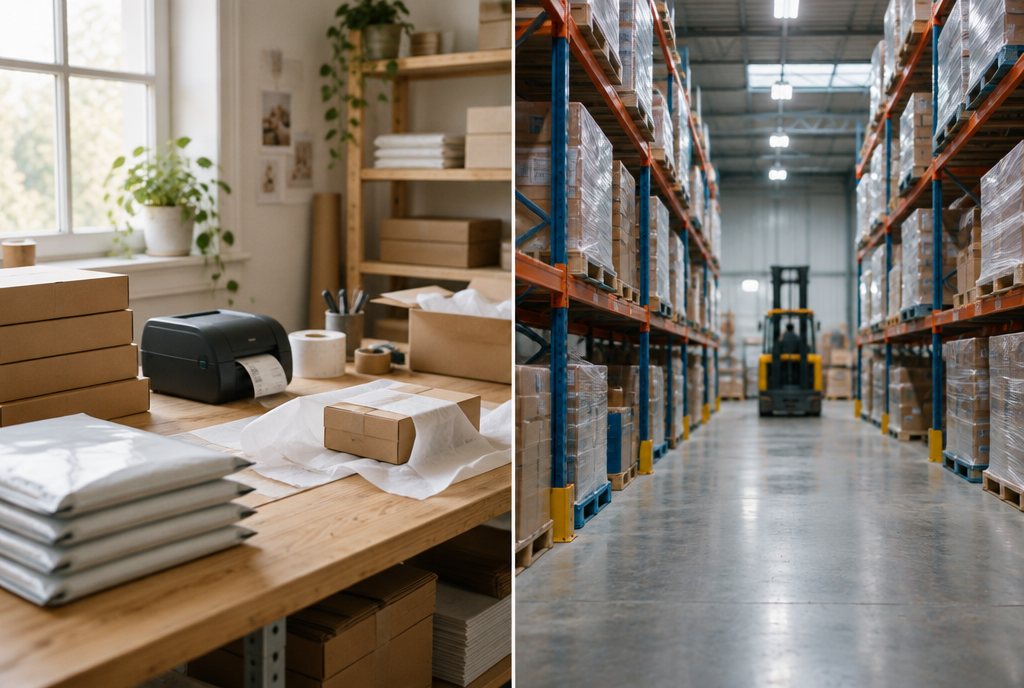
| Factor | In-house | 3PL |
|---|---|---|
| Cost | Fixed (rent, staff, gear) plus low per-order | Variable per order, plus storage and fees |
| Control | Full | Limited to what they offer |
| Speed of change | Same-day | Request and wait |
| Scaling | You add space and labour | They absorb it |
| Brand / unboxing | Easy and cheap | Possible but extra |
Where the maths usually flips
There is no universal cut-off, because a bulky homewares range and a small jewellery line have completely different storage and shipping economics. But as a rough field guide:
- Small or early (roughly under 500 orders a month): in-house almost always wins. A 3PL's minimums and fees rarely pay off at low volume, and you need to understand your own process before you outsource it.
- Scaling with predictable volume: in-house is often still cheaper per order if you have the space and a sensible system. This is the band where most stores jump to a 3PL too early and give away margin they did not need to.
- High volume, multi-state, or no warehouse to grow into: a 3PL usually wins. Once you need east and west coast dispatch, or your lease cannot stretch, the per-order premium buys you reach and capacity you cannot build yourself.
Questions to ask any 3PL before you sign
- What is your Australian coverage? Which states, and do you have more than one node for faster transit?
- Carrier rates: do I ship on your negotiated rates or mine, and do you mark up postage or pass it through at cost?
- How does your Shopify integration actually work? Real-time order sync, inventory write-back, and what happens when it drops out?
- How do you handle returns? Inspection, restocking, the fees, and how fast a returned item is back available to sell.
- What are the minimums? Minimum monthly spend, minimum storage, minimum order counts.
- What is the lock-in? Contract length, exit notice period, and how I get my stock back if it does not work out.
- What are the accuracy and dispatch SLAs, and what happens when they are missed?
The hybrid option
It is not a binary choice. A common middle path is to keep core, fast-moving or high-touch lines in-house, where the brand experience matters, and push bulky, slow or seasonal stock to a 3PL. Some stores run in-house all year and lean on a 3PL only for peak overflow. Others split by geography: ship the east coast yourself and use a 3PL node for WA. Hybrid adds coordination overhead, so it works best once your systems can track stock across more than one location cleanly.
The honest takeaway
Do not outsource a process you have not yet got working, and do not cling to in-house once it is eating all your time and you are out of space. Run the per-order numbers for both at your current and peak volume, then decide. The thing that quietly extends how long in-house stays viable is good software: when picking, packing and stock control are fast and accurate, you can handle far more orders from the same room before a 3PL's per-order fees start to look cheap. A warehouse system like OrderOps is built for exactly that in-house case.
If you do stay in-house, get your peak season fulfilment checklist sorted before November. And if you decide a platform comparison is the next step, our rundown of the best fulfilment platforms in Australia is a good place to start.