Peak season fulfilment in Australia lives or dies on what you lock in before the orders land. This checklist walks through forecasting, carrier readiness, labour, pick/pack throughput, returns and customer comms so your Click Frenzy, Black Friday, Christmas and Boxing Day run is calm rather than chaotic.
The retailers who sail through peak are not the ones who hustle hardest on the day. They are the ones who did the boring prep in September. Work through these six lists and tick them off.
Peak 2026: the dates
These are the dates the checklist below works back from. The Christmas cut-offs are Australia Post's published sending dates for 2026; contract (eParcel) arrangements can differ, so confirm them on your own account too. The Australia Post fuel surcharge is 13.5% for November, up from 11.5% in October, so budget freight for it.
| Date | What happens |
|---|---|
| Friday 27 November | Black Friday |
| Monday 30 November | Cyber Monday, and the last AusPost international economy date to the USA |
| 2 and 4 December | Last AusPost international economy dates to New Zealand (2nd) and the UK (4th) |
| Tuesday 15 December | Last AusPost international courier and express dates to New Zealand, the USA and the UK |
| Wednesday 16 December | Last AusPost Parcel Post date to the NT |
| Friday 18 December | Last AusPost Parcel Post date to WA |
| Monday 21 December | Last AusPost Parcel Post date for most interstate parcels |
| Tuesday 22 December | Last Parcel Post date within the same state, and the last Express Post date to WA and the NT |
| Wednesday 23 December | Last Express Post date within the same state for metro areas |
1. Forecast and stock buffers
You cannot pick what you do not have. Get your stock plan settled early, because supplier and freight lead times stretch right when you need them tightest.
- Pull last year's peak sales by SKU and flag your hero products (the top 20 percent that drive most volume).
- Place reorders on hero SKUs early, with extra lead time baked in for delayed inbound freight.
- Set safety stock on the SKUs you cannot afford to oversell. A stockout on a hero product during a promo is lost revenue you never get back.
- Decide what to do with slow movers now: bundle them, discount them, or set them aside so they do not clog pick faces.
- If you run multiple Shopify stores from one warehouse, reconcile your pooled-versus-independent stock logic before volume spikes so you do not oversell shared inventory.
2. Carrier readiness
Peak is when carrier networks are most congested and least forgiving. Confirm the details that customers will hold you to.
- Get the published peak cut-off and last-postage dates for each carrier in writing, and diarise them. See AusPost cut-off times for how to read them.
- Talk to your account managers about expected capacity and any volume thresholds before you blow past them.
- Plan your carrier mix. A sensible split spreads risk so one network's congestion does not sink every order. Our AusPost vs StarTrack comparison covers where each one earns its keep.
- Re-check your packaging dimensions against cubic weight. Peak volumes magnify any oversized-carton habit into a real freight bill.
- Confirm pickup windows and book extra collections if your daily volume will exceed your usual run.
| When | What to lock in |
|---|---|
| Sep to early Oct | Forecast done, hero-SKU reorders placed, safety stock set |
| Mid Oct | Casual hires confirmed, training booked, packaging consumables ordered |
| Late Oct | Carrier capacity and pickup windows confirmed, peak mix decided |
| Early Nov (pre Click Frenzy / Black Friday) | Bench layout finalised, pick routes set, cut-off banners drafted |
| Mid to late Nov | Promo period live, monitor throughput and dispatch daily |
| Late Nov to mid Dec | Christmas last-postage dates published on site and at checkout |
| Late Dec to Jan | Boxing Day sale + returns surge, redeploy labour to returns |
3. Warehouse and labour
Throwing more bodies at peak only works if the floor and the people are ready for them.
- Hire and train casuals before the rush, not during it. A packer who learns the system mid-promo is slower than no extra packer at all.
- Lay out pack benches to remove walking and reaching: scanner, scale, label printer, consumables all within arm's reach.
- Over-order packaging consumables: satchels, cartons, void fill, tape, thermal label rolls. Running out of labels at 2pm on Black Friday is a self-inflicted wound.
- Keep a spare thermal printer on hand. Printers fail under load, and a dead printer stops a whole bench.
- Write a one-page floor plan: who picks, who packs, who dispatches, and where the overflow goes when benches back up.
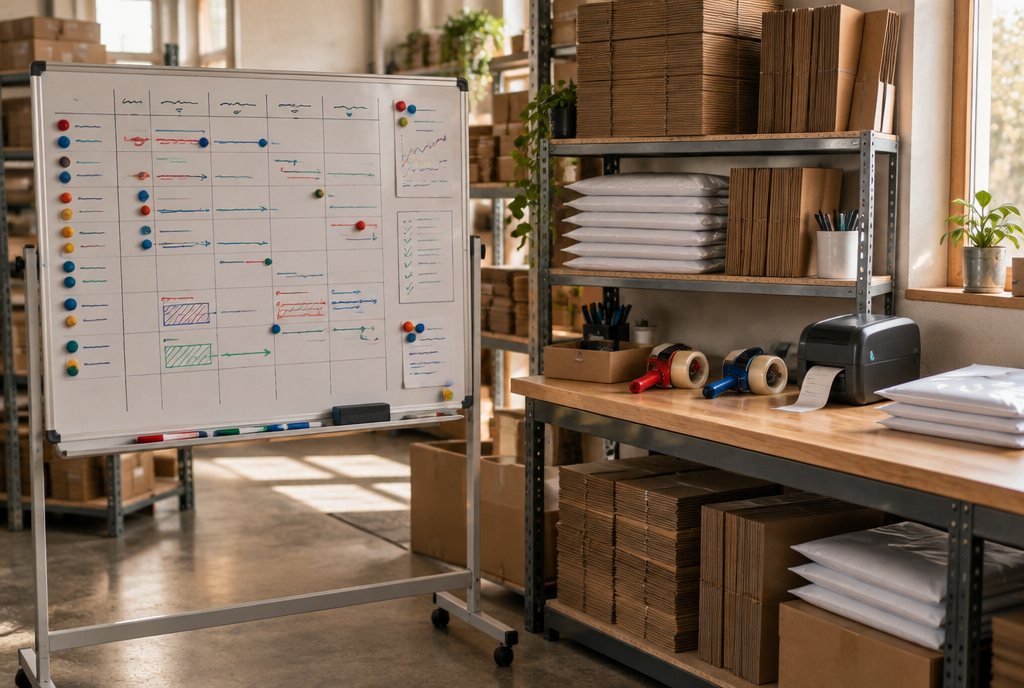
4. Pick and pack throughput
Throughput is where prep turns into shipped parcels. The goal is more orders out the door with fewer mistakes.
- Batch pick. Picking ten orders in one walk instead of ten separate trips is the single biggest throughput lever you have.
- Sequence picks into walking order so pickers move through the floor once, not back and forth.
- Cut mis-picks with a verification step at pack. A wrong item shipped during peak becomes a return, a reship and an angry review. See pick and pack accuracy for practical checks.
- Move hero SKUs to the most accessible pick faces for the duration of peak.
- Generate manifests in bulk at end of day rather than lodging parcels one at a time.
5. Returns surge plan
The parcels you ship in November and December come back in January. Plan for the returns wave before it hits.
- Set aside a dedicated returns area so inbound returns do not collide with outbound dispatch.
- Decide your post-Christmas returns window and publish it clearly. Vague policies create more enquiries than refunds.
- Staff returns processing in January, when Boxing Day dispatch and gift returns overlap. Read ecommerce returns in Australia for a fuller workflow.
- Have a clear rule for restocking saleable returns quickly so that stock goes back on sale during the Boxing Day rush.
6. Customer comms
Most peak complaints are expectation problems, not delivery problems. Tell customers the truth early and you head off the inbox flood.
- Put a shipping cut-off banner on your storefront stating the last order date for Christmas delivery, by carrier or region if needed.
- State realistic dispatch and delivery timeframes at checkout, not best-case ones.
- Send tracking promptly and proactively flag known network delays before customers chase you.
- Draft your standard delay and cut-off email replies now so support can answer fast when volume hits.
The honest takeaway
A calm peak is almost entirely a product of preparation. Forecast early, confirm your carrier dates, train your people before the rush, tighten pick and pack, and set honest expectations with customers. Do that and the busy weeks become routine instead of frantic.
If throughput is your bottleneck, batching, bulk manifests and walking-route pick paths are the levers that move it most, and a warehouse operating system can handle that grunt work for you. See how OrderOps approaches it on features, and if you are still choosing tooling, our roundup of the best fulfilment platforms in Australia is a sensible next read.