If you run a Shopify store in Australia and you're trying to find the best order fulfilment platform, here's the short version: it depends on whether you pack your own orders, automate carrier labels at volume, or sell across marketplaces. We've ranked five good options below for Australian Shopify merchants, and yes, we put ourselves first.
So let's get the obvious bit out of the way before we lose your trust.
There is no single best fulfilment platform for every Australian store. The right one depends on how you actually work. A merchant printing 30 labels a day on a kitchen bench has different needs to one allocating 3,000 parcels across a dozen carriers. So instead of crowning a universal winner, each entry below has a "best for" so you can find yourself in the list quickly.
1. OrderOps: best for AU Shopify merchants who pack their own orders
The origin story is the honest pitch. OrderOps was built by Ivory & Deene, an Australian homewares retailer, because no platform made shipping as simple and calm as Shopify made selling. So they built one for their own floor, and they still run on it every day. It's a warehouse operating system rather than just a shipping app: multi-store Shopify (pooled or independent stock), FIFO cost layers, a full audit log, and roles and permissions for the people who actually touch orders.
Where it earns the top spot for self-packers: an offline-first iPad picker that queues taps and replays them when the wifi drops in the back of the warehouse, a macOS print client that sends raw ZPL straight to a Zebra printer with no print dialog, and a warehouse map that sorts a batch into walking order. You bring your own carrier accounts and negotiated rates. OrderOps doesn't resell postage.
Who should pick it: an Australian Shopify store (or a few stores) that picks and packs in-house and wants the floor to run as smoothly as the storefront. Who shouldn't: if you outsource to a 3PL or need a public API and SAML SSO, look elsewhere for now. Be upfront about the catch. OrderOps is young: self-serve, free for up to 50 orders a month (paid plans carry a 14-day trial), with Australia Post, StarTrack, Team Global Express, TNT and DHL Express live, Aramex in beta, and other carriers integrated on request. See the feature list and pricing if it sounds like your setup.
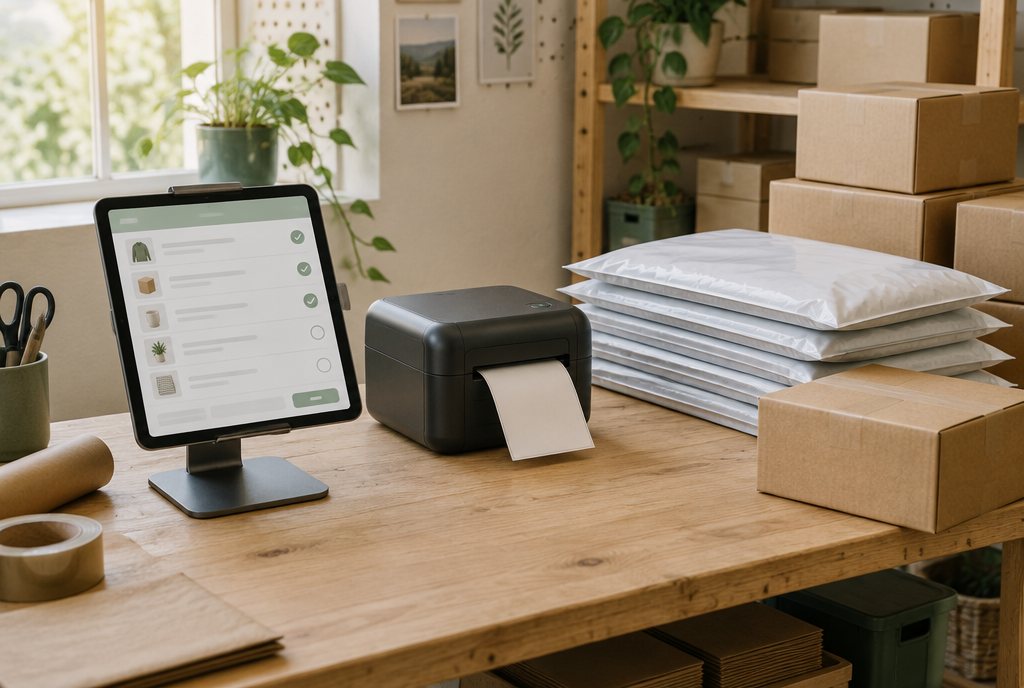
2. Starshipit: best for carrier label automation
Starshipit is built across Australia and New Zealand and is one of the highest-rated shipping apps on the Shopify App Store. Its strength is automating labels and rules at volume, with deep support for Australia Post, MyPost Business and eParcel, plus CouriersPlease, DHL Express, FedEx and a long list of others. If your bottleneck is "too many labels, too many manual steps", this is a strong, mature pick. Best for merchants who want rule-driven label automation against their own carrier accounts and don't need a full pick-pack floor system.
3. Shippit: best for discounted multi-carrier rates
Shippit is a Sydney-based delivery management platform with access to 100+ carriers and pre-negotiated rates, plus allocation logic and tracking. The model is different to bring-your-own-account platforms: you can ship on Shippit's rates and let it pick a carrier for each parcel. That suits growing-to-large retailers who'd rather lean on someone else's freight buying power and delivery tooling than manage a stack of carrier contracts themselves.
4. Easyship: best for international and cross-border
If a meaningful share of your orders cross a border, Easyship is worth a look. It connects to hundreds of couriers, does real-time rate comparison across them, and handles the customs paperwork that trips up first-time exporters. Best for Australian stores shipping a lot of international parcels who want landed-cost visibility and courier choice at checkout rather than a deep domestic warehouse workflow.
5. ShipStation: best for multi-marketplace sellers
ShipStation earns its place if Shopify is only one of your sales channels. It pulls orders from eBay, Amazon, Etsy and more into one queue and has strong batch label automation. Best for sellers juggling several marketplaces who want a single place to print and track, and who care less about Australia-specific carrier depth than about channel coverage.
The five at a glance
| Platform | Best for | Carrier model |
|---|---|---|
| OrderOps | AU Shopify merchants who pack their own orders | Bring your own carrier accounts |
| Starshipit | Carrier label automation (AusPost, MyPost, eParcel) | Bring your own carrier accounts |
| Shippit | Discounted multi-carrier rates and delivery management | Pre-negotiated rates across 100+ carriers |
| Easyship | International and cross-border shipping | Hundreds of couriers, rate comparison |
| ShipStation | Multi-marketplace sellers (eBay, Amazon, Etsy) | Multiple carriers, label batching |
How to actually choose
Don't pick on the feature matrix alone. The differences that matter only show up once real parcels are moving through the system.
- Find yourself in the "best for" lines above and shortlist two platforms, not five.
- Trial both on a normal week of orders, including a few awkward ones: international, oversized, a refund and return.
- Decide whether you want to bring your own negotiated carrier rates or buy postage through the platform, because that splits this list in two.
- Time the boring loop: order in, picked, labelled, manifested. Whichever shaves the most minutes per parcel usually wins.
If your decision comes down to carriers, our Australia Post vs StarTrack comparison lays out where each is strongest, and if the real goal is a smaller postage bill, start with reducing shipping costs on Shopify in Australia.
The honest takeaway
We think OrderOps is the best fit for Australian Shopify stores that pack their own orders, and we're honest that it's early: five carriers live, one in beta. The other four are real, capable platforms, and for plenty of merchants one of them is the right call. Shortlist by who each is best for, trial two, and let your actual parcels decide. If you do pack in-house, start free — 50 orders a month on us — or book a walkthrough.