Cubic weight (also called volumetric or dimensional weight) is how carriers charge you for the space a parcel takes up rather than what it weighs on the scale. A light, bulky parcel costs more than its actual weight suggests because the carrier bills you on whichever is greater: the dead weight or the cubic weight. Here's how the Australian domestic calculation works, with worked examples and practical ways to bring the charge down.
Dead weight vs cubic weight
Two numbers describe every parcel you send:
- Dead weight (also actual or scale weight) is what the parcel weighs when you put it on the scales. A 20 kg box of tiles is heavy and dense, so its dead weight does the talking.
- Cubic weight is a weight figure derived from the parcel's size. It converts the volume your box occupies into an equivalent weight, because a truck or plane runs out of room before it runs out of payload.
A delivery van fills up with cushions, doonas and lampshades long before it hits its weight limit. The carrier still has to pay for that space, so they invented cubic weight to charge for it. For most parcels the dead weight is higher and nothing changes. The moment your parcel is light but bulky, the cubic weight takes over.
Why carriers charge on whichever is greater
The carrier compares the two figures and bills you on the larger one. This is called the chargeable weight. It protects them from sending a near-empty van full of pillows for the price of a single kilogram, and it protects them from being underpaid for a small lead brick that barely registers on volume. You don't get to pick the cheaper number, so the only lever you control is the parcel itself.
The Australian domestic cubic conversion
The standard Australian domestic cubic conversion is commonly 250 kg per cubic metre. You work out the parcel's volume in cubic metres and multiply by 250. Confirm your carrier's current figure, because conversion factors differ between domestic, express and international services and they do change.
In plain steps:
- Measure length, width and height in centimetres.
- Multiply the three together to get the volume in cubic centimetres (cm³).
- Divide by 1,000,000 to convert to cubic metres, then multiply by 250. The shortcut is to divide the cm³ figure by 4,000. It gives the same cubic weight in kilograms.
So cubic weight (kg) = L × W × H (cm) ÷ 4000. A 40 × 30 × 20 cm box is 24,000 cm³, which divided by 4,000 gives 6 kg of cubic weight. Confirm the divisor with your carrier before you rely on it for quoting.
Worked examples
Three parcels, same conversion, very different outcomes. The chargeable weight is the larger of the two columns.
| Parcel | Dimensions (cm) | Dead weight | Cubic weight (÷4000) | Charged on |
|---|---|---|---|---|
| Light, bulky pillow | 60 × 40 × 30 | 1.5 kg | 18 kg | Cubic (18 kg) |
| Small, dense item (e.g. tools) | 20 × 15 × 10 | 3 kg | 0.75 kg | Dead (3 kg) |
| Medium homewares carton | 45 × 35 × 25 | 6 kg | 9.8 kg | Cubic (9.8 kg) |
How to measure parcels correctly
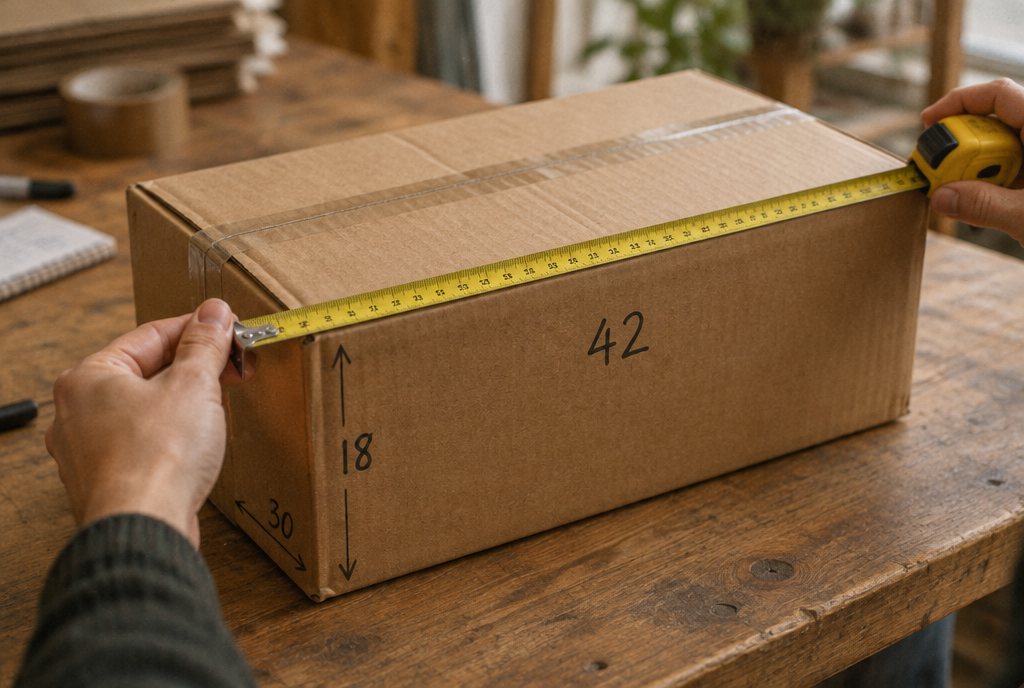
Carriers measure the box as it actually ships, not the flat-pack dimensions on the spec sheet. Get this wrong and you'll be reweighed and re-rated after dispatch, usually with a surcharge.
- Measure the longest point of each dimension, including any bulge, lid overlap or taped seam that sticks out.
- Measure the packed box, not the product. A small item in an oversized carton ships at the carton's size.
- Round up to the nearest centimetre. Most carriers do, so match them or you'll under-quote.
- For satchels and soft parcels, measure the bag once it's stuffed and sealed, at its thickest point.
Practical ways to reduce cubic charges
If your parcels are bulky and light, cubic weight is probably your single biggest controllable cost. The fixes are unglamorous but they work:
- Right-size your boxes. Hold a small range of carton sizes that fit your actual products. Every empty centimetre is paid airspace.
- Use satchels for soft, squashable goods. Apparel, linen and soft furnishings often ship far cheaper in a satchel than a box because they compress.
- Compress the void. Swap bulky bubble wrap and loose fill for thinner protective materials where the product allows, and don't pad a box just to fill it.
- Flat-pack or nest where you can. Knock-down furniture and stackable items cut height, which is usually the most expensive dimension.
- Check the satchel-vs-box maths per SKU. Sometimes a flat-rate satchel beats a cubic-rated box even when it looks bigger.
There's more on the broader cost side in our guide to reducing shipping costs for Shopify stores in Australia, and if you're weighing up carriers, Australia Post vs StarTrack compares how the two handle bulky freight.
The takeaway
Cubic weight isn't a scam, it's the carrier charging for space they can't sell twice. Measure your packed boxes honestly, round up, and assume bulky-but-light parcels will be billed on volume. If you're not sure which way a given parcel falls, the safest move is to compare live carrier quotes against your own account rates before you commit a packaging spec. Live rate quotes using your negotiated contract make that comparison concrete rather than theoretical.